EMPWR: Knowledge Graph Development Platform
Contents
Background and Motivation
Knowledge Graph (KG) is an encapsulation of structured knowledge in a graphical representation & used for a variety of information processing and management tasks such as
- Data & knowledge integration from diverse sources
- Improve automation
- Enabling new generation of applications
- Empowering machine learning (ML) & NLP techniques with domain knowledge
and applications such as question answering, summarization, text simplification, and Named Entity Recognition (NER).
Most existing KG platforms & tools are limited in
- Provenance
- Dynamicity (ie: static schema vs schema generation)
- Temporal
- Domain specificity
- Modularity
The AIISC Knowledge Graph (KG) EMPWR effort involves the development of a comprehensive tool and platform for KG development with the following aims
1. Develop a KG development platform capable of instantiating KGs in any domains from structured, semi-structured, and unstructured data:
- Biomedical & pharmaceutical domain with Percuro
2. Improve & address the limitations of existing KG platforms
3. Constructs a Knowledge Graph (based on a combination of)
- Enrich an existing Knowledge Graph (Top-down declarative)
- Construct a Knowledge Graph out of given entities (Bottom-up data driven)
Goals & Use-Cases
The goals of KGs are to provide
- Contextualization
- Personalization
- Abstraction
- Explainability
Collaborations
Percuro is a collaborative research project involving WIPRO, The AI Institute at University of South Carolina (AIISC), and IIT-Patna (IIT-P). It involves development of semantic (i.e., knowledge graph enhanced) approach to natural language processing (NLP), natural language generation (NLG) and natural language understanding (NLU) targeted at the pharmaceutical domain. It will involve techniques for NLP/NLG/NLU on biomedical and clinical documents relevant to pharmaceutical markets.
Percuro aims to solve tasks such as (a) text simplification, (b) summarization and (c) question answering. These are tasks that are not straightforward and require more information that what the text provides.
Project: Multimodal Knowledge Graphs (MMKGs) Construction and Analysis to Accelerate Pharmaceutical Drug Discovery with EMPWR
One of the main challenges in the pharmaceutical industry is navigating and integrating vast, heterogeneous datasets, from scientific literature and clinical trial results to genomic and molecular data. Knowledge Graphs (KGs) have emerged as a powerful and promising technology to structure this information, representing real - world entities like drugs, diseases, and genes as nodes, and their relationships as edges. However, building and maintaining these KGs is a complex, and continuous process. The EMPWR platform is a comprehensive solution designed to manage the entire KG lifecycle. It was developed to bridge the gap between traditional symbolic AI systems, which are explainable but difficult to scale, and modern data - driven systems like deep learning and transformer - based models, which are powerful but often function as "black boxes".
<img src="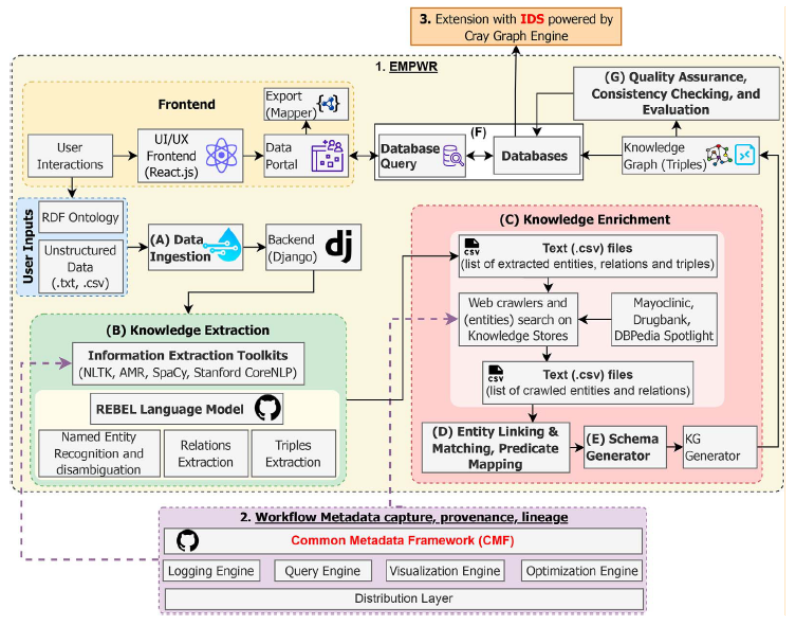 " width="350" height="370" alt="Subfigure 1">
Overview
Toolkit
The Knowledge Graph Toolkit (EMPWR) V1.0 currently supports knowledge sources from:
- PharmKG (base)
- Open-domain: DBpedia & Wikidata
- Biomedical & pharmaceutical domain: Drugbank & UMLS
and has an extensive coverage over the domains of Drugs, Chemicals, Diseases entities and their associated relations:
- Chemical: Drug interactions, diseases cured, etc.
- Physical: Lethal dosage, boiling point, pressure, solubility, etc
- Disease: Symptoms, treatments, differential diagnosis, etc.
- Aliases: Common names, chemical names and external identifiers.
GitHub
Demo
[NEW]
Tutorial
- H.Y. Yip, R. Wickramarachchi, R. Venkataramanan, A. Sheth. "Knowledge-driven Processes for Big Data Management and Applications", In IEEE International Conference on Big Data, December 2024
- H.Y. Yip, and A. Sheth. “Data and Knowledge-Driven Processes for the Knowledge Graph Lifecycle”, In Sixth International Knowledge Graph and Semantic Web Conference (KGSWC), December 2024
Paper
People
- Artificial Intelligence Institute, University of South Carolina
- Development Team
- WiPRO
